Ambassador Bruton's Weekly Message

WEEKLY MESSAGE FROM AMBASSADOR JOHN BRUTON

May 5, 2009

Why do poor people live shorter lives?

Last week I met Pierre Vigilance who heads up the Department of Health in Washington, DC. His main rôle is in promoting public health, as distinct from dealing with illness or health insurance.

He told me that the major public health concern in the city is containing the spread of HIV/AIDS and promoting behaviour that will reduce it.

A recent McKinsey study shows that there are inequalities in health insurance coverage. Only 22% of workers in the lowest paid jobs in the US have employer-paid insurance coverage as against 81% in the upper middle income group.

Pierre VigilanceBut Pierre Vigilance told me health insurance on its own was not the most important source of health inequality. Rather it was whether people who were financially badly off had a chance to lead healthy lives, and whether medical professionals have as good incentives to promote illness prevention as the ones they have to treat people once they become ill.

He said poverty was a major cause of ill health. As he put it, poverty is stressful. If you do not have enough money to meet your weekly bills, you will suffer from stress. And stress leads to illness. There is a physiological link between stress and obesity, and obesity leads to a range of other serious health problems including heart failure.

The conditions in urban neighbourhoods in which poor people are concentrated are often not conducive to a healthy lifestyle or to taking exercise. Illness

Such neighbourhoods often do not have shops which sell fresh vegetables. Instead they have fast-food restaurants, which dispense meals loaded with sugars, fats, artificial flavours and salt.

If there is also a high concentration of crime in the area, people will not feel safe in going for a walk to take exercise.

My conversations with Dr. Vigilance reminded me of some statistics from the National Institutes of Health I saw a while ago, which suggested that life expectancy varies directly with the amount of schooling and with family income. As a result, the gap in life expectancy between those who are less educated and poor, and those who are well educated and well-off has widened over the past 20 years.

Major Economies Forum - A time for leadership on climate change

Last week I attended an address by Senator John Kerry to the delegates at the Major Economies Forum on Energy & Climate. The Forum is preparing for the UN Climate Change conference in Copenhagen in December. He made a number of telling points and these were enhanced by the fact that he was speaking on an unseasonably hot April day.

John KerryHe said that a 25-mile-long ice bridge in the Antarctic, which had existed for thousands of years, had recently melted away; furthermore the melting of the ice cap in Greenland was releasing methane gas that had been safely trapped for millennia into the atmosphere, and methane gas is even more damaging than CO2.

The US legislation to impose limits on carbon emissions in the United States is vital if other countries, like India and China, are to be persuaded to put limitations on their greenhouse emissions.

It is not an excuse to say that the problem can be dealt with just by investing in new technologies. With the exception of heat conservation in buildings, the new technologies involve significant upfront capital costs. And those capital costs are all too easy to postpone, unless there is a price placed on doing nothing and a reward for doing something. A global cap and trade system would create incentives for the adoption of energy saving technologies everywhere and that is why it is so important.

A recent McKinsey study suggests that we need the equivalent of another industrial revolution to reduce the carbon intensity of our economy to a level that will avoid disastrous climate change. The study says that, by 2050, we must move from our present efficiency level where the consumption of a tonne of carbon on average produces $750 worth of income, to one where it will produce $7,500 - a tenfold increase in our "carbon productivity." To do this by 2050 would involve a faster rate of increase in productivity than occurred during the Industrial Revolution.

Climate Change

The capital investments needed to make this big increase in carbon productivity will be large, but they will be much less than the costs we will incur if we do nothing, and if climate change goes ahead unabated.

Mobile phones - changing the way the world livesEsko Aho

Last week I met Esko Aho, the Prime Minister of Finland from 1991-1995, who is now Executive Vice President and member of the Board of Nokia. He told me that his firm is the biggest investor in R&D of any European company and is the 3rd biggest investor in R&D in the entire world.

The mobile phone has connected people in the poorest countries to each other and to the rest of the world in a way that no previous technological advance was capable of doing. Last December, the 4th billion mobile phone was sold! He told me that there are 400 million mobile phones in India, as against a mere 40 million fixed telephone lines. The mobile phone enables an Indian farmer working in his field to keep in touch on an hourly basis with global prices for the product he is producing. It thus reduces inequality of knowledge in the global marketplace, something that is vital if inequality of incomes is to be reduced.

Cell PhoneThe global success of the mobile telephone industry is the result of heavy investments in R&D of companies like Nokia. Nokia conducts R&D in the US, notably in Silicon Valley and San Diego. Nokia wants to be a services provider, not only a devices provider.

Telephone and broadband network - let's have some real competition

I also met Sir Michael Rake, Chairman of the BT Group last week (he is also Chairman of the UK Commission for Employment and Skills, a member of the Department of Trade US/UK Regulatory Task Force and a member of the Board of the Transatlantic Business Dialogue). His company is already active in the United States, but he told me that it is facing regulatory obstacles in offering the full range of BT's services to US businesses and consumers. The cost of linking BT fiber optic lines into a fixed line network, that is owned by BT's American competitors, has been kept artificially high. Incumbents have a monopoly in "last mile" access in the US enterprise market, and there is very little competition between cable and incumbent telecoms providers in the US consumer market. BT is looking for a level playing field in the EU, as well as in the US. He believes that more competition in the broadband services sector in the US would allow the cost of broadband to American enterprises and homes to come down substantially. This would help American consumers and would be in line with President Obama's stimulus plans.

Telecommunications

Euro Challenge Final in New York - young Americans come to grips with the economic crisis

Last week I visited New York to congratulate the finalists in the Euro Challenge. The Euro Challenge allows teams from 70 high schools from 9 different US states to compete in making presentations on the economic problems of individual European countries in the euro zone.

The high school students individually act out different rôles, such as Finance Minister of a country, Central Bank governor, representatives of business interests, etc. They debate the problem of "their" country in front of an audience and then submit themselves to questions from a panel of experts. I was immensely impressed by the standard of knowledge attained by the students.

The competition is run by the Delegation of the European Commission here in Washington in conjunction with the Federal Reserve Banks of New York, Chicago, Boston and Atlanta (Miami branch), the Moody's Foundation, the EU Centers of Excellence in Miami, Chapel Hill, Michigan and Pittsburgh, as well as the European Union Center at the University of Illinois; Crédit Suisse and Deloitte & Touche. More information can be found at http://www.euro-challenge.org/.

This year's competition was won by Montclair High School from Montclair, New Jersey [shown below]. The runner-up was North Allegheny Intermediate High School from Pittsburgh, Pennsylvania.

In congratulating the contestants, I said that each European country was differently affected by the current economic crisis. Some, which had experienced overheating of their economies in the last 20 years (Sweden and Finland) had been more cautious this time, and were doing relatively well now, as were Poland and Slovakia. But the countries that had recently grown fastest with easy credit (Ireland, Spain and the Baltics) were now suffering the most.

Euro Challenge 2009

The crisis can be overcome. Martin Wolf of the Financial Times recently claimed that the stimulus needed to overcome the current crisis will cost us only a tenth as much as the eventual cost of the ageing of our population will cost us. The real crux is the distribution of the burden. Some people who lose their jobs will lose a lot, while others with secure jobs will lose little. That's why the problem is as much a political one as an economic one.

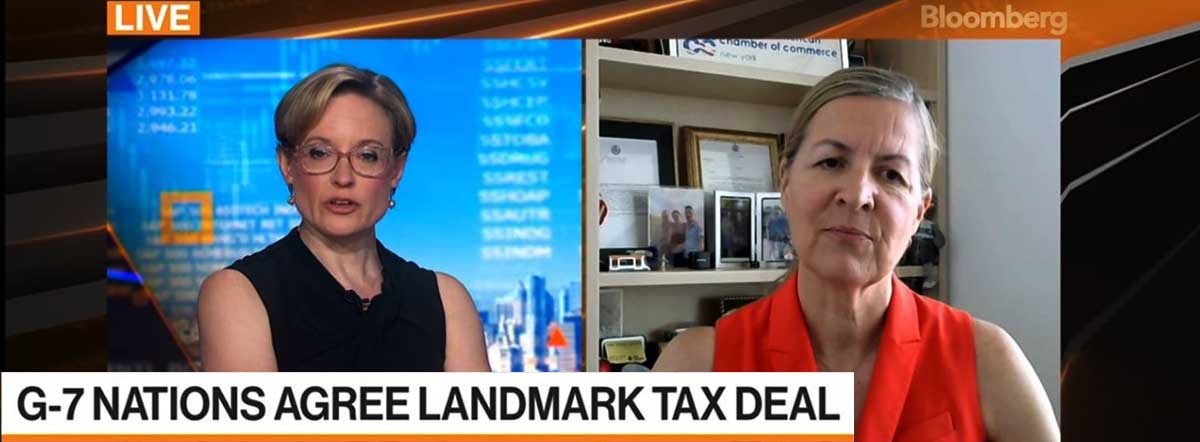
During my visit to New York I gave interviews to Tom Keene from Bloomberg Radio, Alexis Glick from the Fox Business Network and Moira Herbst and David Rocks from BusinessWeek.

I also had a meeting with the European-American Chamber of Commerce, which is based in New York and of which I am privileged to be the honorary president.

EU Open Day

On May 9, the Embassies of the European Union and the European Commission Delegation in Washington open their doors to the public, offering a rare behind-the-scenes look at "Embassy Row," and other diplomatic enclaves around the city.

During the day-long festival, visitors have a unique opportunity to experience the many rich and diverse cultures of the EU through song and dance, family entertainment, film, art exhibits, wine-tastings and delicacies from embassy chefs.

European Union Open House

In what has become an increasingly popular annual event, we are pleased to invite the mid-Atlantic community to take a "short-cut to Europe." For more information, please go to: http://www.eurunion.org/EUinUS/eu-open-house .

Please send me your comments about this or any of my weekly messages or other EU matters. I look forward to hearing from you!

For more information please click: Ambassador Bruton's Website